You can eat soft foods 1 to 2 hours after getting braces, once any numbing wears off. Soreness peaks on days 2 to 3, most people chew comfortably again by day 5, and everyday meals feel normal in about a week. Hard, sticky, and chewy foods stay off the menu for the whole treatment, but the day-to-day diet returns fast.
The short answer: soft foods in 1 to 2 hours, normal eating in about a week
There is no numb-mouth waiting period the way there is after a filling unless your orthodontist used a local anesthetic. Braces themselves do not stop you from eating. What limits you in the first few days is tenderness, not the brackets. Your teeth are sore because the wire has started moving them, and that ache follows a predictable curve.
Here is the whole timeline at a glance:
| Time after braces | What you can eat | What to skip |
|---|---|---|
| First 24 hours | Cool, soft, no-chew foods: yogurt, smoothies, mashed potatoes, oatmeal, scrambled eggs | Anything you have to bite; anything hot |
| Days 2 to 3 (peak soreness) | Soft foods plus lukewarm soup, soft pasta, well-cooked rice, tender fish | Crunchy, chewy, and firm foods |
| Days 3 to 5 | Soft-cooked vegetables, ripe fruit, tender chicken, meatballs, small bites of soft bread | Biting with the front teeth; hard textures |
| Week 1 | Most foods, cut small: tender steak, soft sandwiches, pasta, cooked vegetables | The permanent avoid list only |
| Weeks 1 to 2 | Your regular diet, minus the avoid list | Hard, sticky, and chewy foods for the rest of treatment |
Day-by-day: when you can eat what after braces
Everyone recovers a little differently, but the pattern after new braces is remarkably consistent. Here is what to expect on each day.
First 24 hours: cool, soft, no-chew foods
Your teeth and gums are tender from the bracket placement, the first gentle pressure of the wire, and any cheek retractor used during the appointment. Stick to cool, smooth foods that need almost no chewing.
Good choices: yogurt, smoothies, applesauce, mashed potatoes, oatmeal, pudding, scrambled eggs, soft cheese, and a small amount of ice cream. Skip anything you have to bite into, anything hot enough to sharpen the sensitivity, and anything with seeds or husks.
Days 2 to 3: soreness peaks, stay on soft foods
This is usually the hardest stretch. Tooth soreness peaks somewhere between 24 and 72 hours, then fades steadily. Stay on soft foods and add lukewarm options like soup, soft pasta, well-cooked rice, and tender fish.
Cold water, ice chips, and a saltwater rinse (half a teaspoon of salt in 8 ounces of warm water) take the edge off. Over-the-counter pain relievers help if your orthodontist has cleared them for you.
Days 3 to 5: most people chew comfortably again
Most patients can chew on the back teeth comfortably by day 4. Soft-cooked vegetables, ripe fruit like banana, peach, or melon, tender chicken or meatballs, and small bites of soft bread are usually fine now.
Cut every food into small pieces and chew on the back molars rather than biting with the front teeth. The bonding that holds the brackets needs a few days to reach full strength, so give it a week or two before you test it.
Week 1: nearly every food is back except the avoid list
By the end of the first week, most foods are back on the menu apart from the permanent avoid list below. You can add tender steak, soft sandwiches, pasta with sauce, and most cooked vegetables.
Weeks 1 to 2: eating feels normal again
By day 10 to 14, eating feels close to normal. You will keep skipping hard, sticky, and chewy foods for the length of treatment, but your everyday meals look a lot like they did before braces.
Why your teeth hurt for the first 3 days, and what eases it
The discomfort comes from three sources, and each one has a fix:
- Tooth pressure from the wire nudging teeth into new positions. Soft foods lower the chewing force, and warm saltwater rinses calm the ligament around each tooth root.
- Cheek and lip irritation from brackets rubbing soft tissue. A bit of orthodontic wax pressed onto any sharp edge gives your cheek time to toughen.
- Gum tenderness from the retractor used during placement. Cool foods and gentle brushing for the first 48 hours let the gums settle.
If the pain is sharp, stays in one spot, or gets worse after day 3, contact your orthodontist. That pattern usually points to a single bracket that needs a small adjustment, not a longer recovery.
Soft foods that work in your first week with braces
For the full breakdown, see our complete guide to what foods to eat in your first week with braces. The quick version:
- Soft carbs: mashed potatoes, well-cooked pasta, oatmeal, soft bread
- Tender protein: scrambled eggs, soft fish, tofu, ground meat, well-cooked chicken
- Dairy: yogurt, cottage cheese, smoothies, soft cheese
- Cooked produce: applesauce, banana, ripe melon, soft-cooked spinach, zucchini, peas
- Comfort foods: soup, custard, pudding, smoothie bowls
Foods to avoid for the rest of your braces treatment
Some foods stay off the menu until your braces come off. They are the main cause of broken brackets and emergency visits. The full list is in our foods to avoid with braces guide, and the big ones are:
- Hard: nuts, hard candy, ice, popcorn kernels, raw carrots, hard pretzels
- Sticky: caramel, taffy, chewing gum, gummy candy, dried fruit, especially raisins
- Chewy: bagels, tough jerky, chewy bread crusts
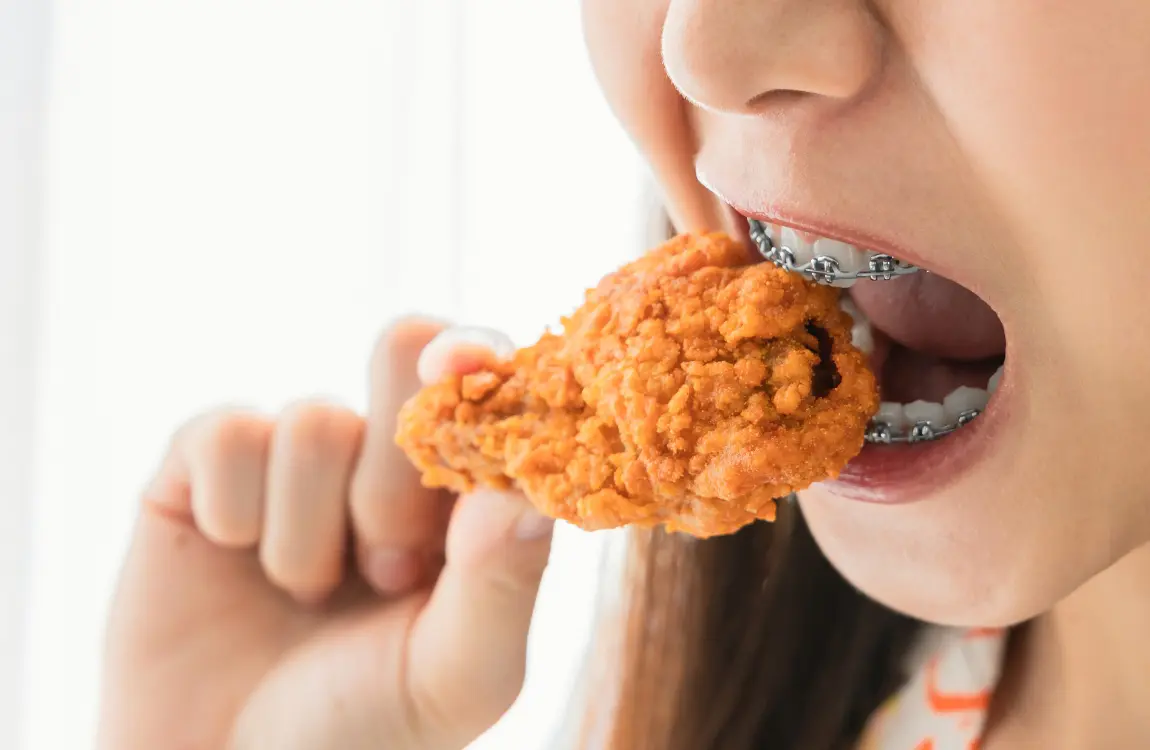
- Bite-into: apples, corn on the cob, ribs (cut these off the bone or core first)
Chips are the food patients ask about most, and the answer depends on the chip. As Dr. Polina Ingberman puts it, "You can eat soft chips like potato chips, but not hard chips like tortilla chips because they can damage the braces." Gum has a simpler answer. In her words, "you should not chew gum with braces as it can cause the braces to break."
How to chew with braces without breaking a bracket
Cut, do not bite
Use a knife to cut food into pieces small enough to drop straight onto the back teeth. Biting with the front teeth puts shearing force on the brackets that carry the most pressure during alignment.
Use the back teeth
Most of your chewing should happen on the molars. They are anchored more firmly and have a larger surface, so they spread the load.
Chew slowly
Slow, deliberate chewing softens the impact if you bite into something harder than you expected. It also helps digestion while soreness limits how thoroughly you can chew.
Brushing after meals stays important with braces. See our guide to how to clean braces and teeth properly.
When to call your orthodontist if eating still hurts after a week
Some discomfort is normal in the first week. Call your orthodontist if any of these is still true past day 5 to 7:
- Sharp, localized pain on a single tooth when you bite
- One bracket feels noticeably looser, sharper, or out of position
- A wire is poking your cheek and orthodontic wax is not enough
- You see swelling, bleeding, or a sore that is not healing
- You cannot tolerate even soft foods after 5 days
None of these means treatment is failing, and each one is fixable in one short visit.
Most people are back to soft solids within a day of getting braces and chewing comfortably within a few days. When discomfort lingers past day 5, it often traces to a single high-contact bracket, which an orthodontist can ease in a quick adjustment. That is worth a phone call rather than waiting it out.
Frequently asked questions
Can I eat solid food the day I get braces?
Soft solids, yes. Hard or chewy solids, no. Most patients eat yogurt, smoothies, mashed potatoes, scrambled eggs, or soup within a few hours of leaving the office. Save crunchy and chewy foods for at least week 2.
How long does the soreness after braces last?
Soreness peaks at 24 to 72 hours and eases for most people by day 5. By day 7, usually only mild pressure remains during chewing, not pain.
What if my braces hurt every time I eat?
Past day 7, persistent pain when you eat usually means a single bracket needs adjustment. That is a short fix at the office and not a sign that treatment is going badly.
Can I drink coffee or soda right after getting braces?
Coffee and tea are fine, just let them cool to lukewarm in the first 48 hours while your teeth are sensitive. Soda is best avoided long term because the sugar and acid raise cavity risk around the brackets, though a small amount in the first week will not hurt.
Does Invisalign make eating easier than braces?
Invisalign is removed for meals, so there are no food restrictions while you eat, but the trays must be reinserted so you reach at least 22 hours of wear a day. See our Invisalign page for how that compares to braces.
Will each adjustment hurt like the first time?
Each adjustment causes mild soreness for 1 to 3 days, but it is much gentler than the initial placement. Most patients return to normal eating within 24 to 48 hours of an adjustment.
Schedule your Brooklyn orthodontic consultation
If eating is still uncomfortable after your first week, or you are weighing braces against Invisalign, our team is happy to walk you through what to expect. Call Brace Central Orthodontics in Brooklyn at (718) 998-1888 or book a consultation to get started.
Disclaimer: This information is provided for educational purposes and is not a substitute for professional medical advice, diagnosis, or treatment. Please schedule a consultation with our team to discuss your individual needs.