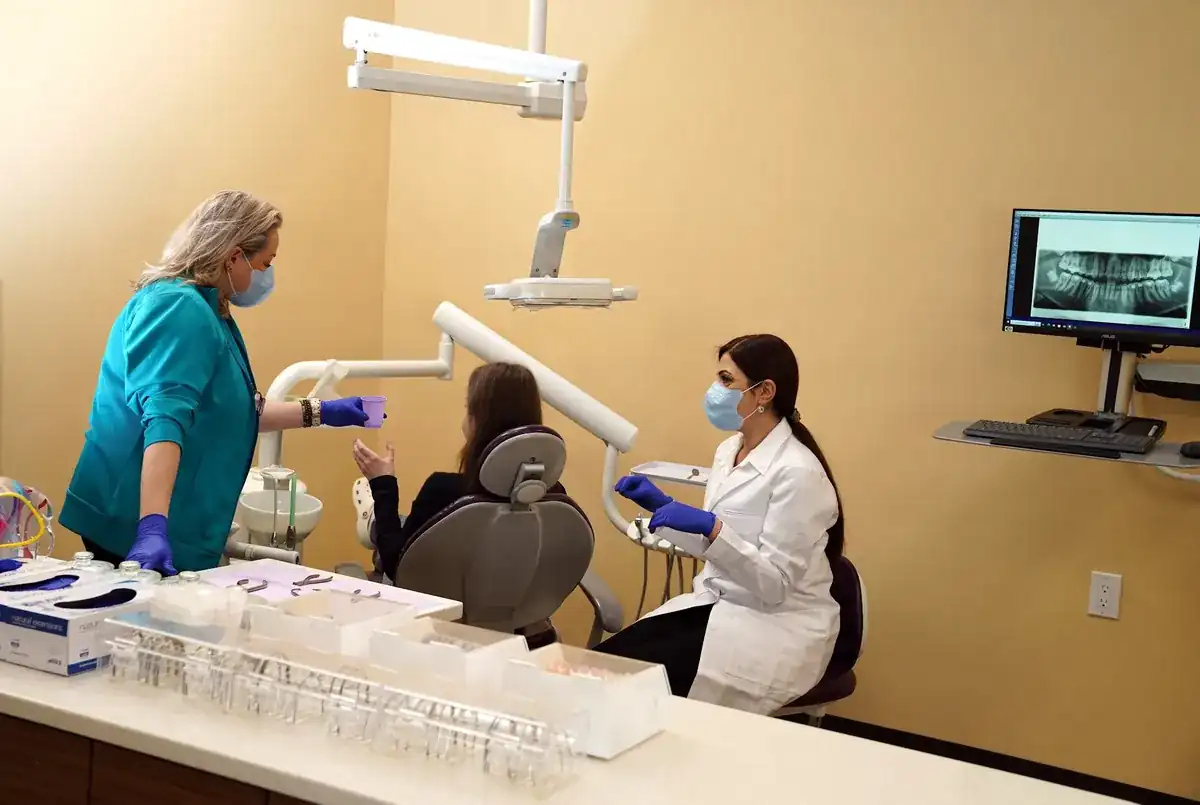

Yes, braces are one of the main ways to improve an overbite. The braces move your teeth into better positions, and small elastic bands are often added to guide the upper and lower teeth toward a healthier bite. Most overbite treatment with braces takes about one to two years, with milder bites often finishing sooner and severe or jaw-related cases taking longer. Your exact timeline depends on your case and is reviewed at your consultation.
An overbite is when your top front teeth overlap the bottom ones more than they should. A small overlap is normal. When it gets deep, it can wear down the lower teeth, strain the jaw, and make cleaning harder. If you already know you have one, the real questions are how braces move it and how long you'll be in treatment. Here's what that looks like.
How do braces improve an overbite?
Braces work in stages. First, a wire runs through the brackets on your upper and lower teeth and slowly straightens and levels them. Once the teeth are aligned, the focus shifts to the bite itself. This is where small elastic bands usually come in. They hook from the upper brackets to the lower ones and apply steady, gentle pressure that guides the jaws into a better relationship over time. Wearing the elastics as directed matters, because the bite moves only while that light pressure is on.
The starting point is an exam and a set of records. At Brace Central Orthodontics, that means digital impressions with an iTero scanner, photos, and a radiographic evaluation, so your orthodontist can see whether the overbite is coming from the position of the teeth, the jaw, or both. That answer shapes the whole plan. When the teeth are in their new positions, a retainer holds everything in place while the surrounding bone settles.
Because the bite is being guided rather than forced, an orthodontist designs the sequence for your case rather than following a fixed script. You wear metal, ceramic, and self-ligating braces chosen to fit the movement your bite needs.

How long does overbite treatment with braces take?
Timing tracks the severity of the overbite and whether other things need moving at the same time. As a general guide across orthodontics, a mild overbite can often improve in under a year, a moderate one commonly takes around one to two years, and a deep or jaw-related overbite can run beyond two years. A deep overbite is one of the longer bites to work on, partly because it usually comes with crowded or crooked teeth that need attention too.
Two things stretch or shorten that window: how consistently you wear your elastics, and how your teeth respond. There's no way to name an exact number in advance, which is why an honest timeline comes after the exam. At Brace Central Orthodontics, treatment time varies by case and is discussed at your consultation.
After 2 years of braces and getting them taken off I cannot express how happy I am with the results!
Kai
Do you always need surgery for an overbite?
No. Most overbites improve with braces and elastics alone, and many patients never need anything more. Surgery enters the picture only in specific situations, usually a severe overbite in an adult where the jawbones themselves sit far out of alignment. In those cases, braces are combined with a jaw procedure done by an oral surgeon, and the orthodontist and surgeon coordinate the plan together. Brace Central Orthodontics coordinates surgical orthodontics for the cases that call for it, so a complex bite is handled in one coordinated plan instead of leaving you to arrange it yourself.
For a growing child or teen, the jaw is still developing, which often makes surgery unnecessary. That is one reason an early exam is worth it: it is easier to guide a bite while the jaw is still growing than to move it later.
Overbite treatment for kids, teens, and adults
Overbites show up at every age, and braces improve them at every age. The approach shifts with the patient. In children, an orthodontist can use that natural jaw growth, and an appliance such as a palate expander is sometimes added to make room and steer the bite before or alongside braces. Teens are often in a good window because the jaw is still settling. Adults get real results too, since braces move teeth throughout life, though a fully grown jaw means some deep bites take a bit longer.
Brace Central Orthodontics treats children, teens, and adults, and the office works with patients in English, Russian, and Ukrainian.
She took her time to form a plan designed for my teeth and oh my goodness I'm so happy with my decision.
Nikisha Brathwaite
Metal, ceramic, or clear aligners for an overbite?
Braces come in more than the classic metal style. A deep overbite that relies on elastics to guide the bite is often a strong fit for braces, and both traditional metal and tooth-colored ceramic brackets do that job. Clear aligners improve many bites as well, and Brace Central Orthodontics is an Invisalign Pearl Provider, though which option suits a particular overbite depends on how much the bite needs to move. Your orthodontist walks you through braces or clear aligners for your case after seeing your records, so the choice is based on your bite rather than a guess.
Overbite treatment at Brace Central Orthodontics in Brooklyn
Brace Central Orthodontics improves overbites for children, teens, and adults across South Brooklyn, with each plan designed and overseen by an orthodontist. The practice was founded by Dr. Polina Ingberman, who graduated first in her class at NYU College of Dentistry and completed her orthodontic training at Columbia, and the team includes Dr. Amalya Igityan, a board-certified Diplomate of the American Board of Orthodontics. Records are taken with an iTero scanner, and the team treats patients in English, Russian, and Ukrainian.
If an overbite is bothering you or your child, call (718) 998-1888 for a free consultation, or reach the Brace Central Orthodontics office with your questions.
Frequently asked questions
Do braces for an overbite hurt?
Most people feel pressure and some soreness for a few days after braces are placed or adjusted, and again when new elastics change the pull on the bite. It eases as your teeth settle, and over-the-counter pain relief usually covers it. Steady, gentle pressure is how the bite moves, so a little tenderness is a sign it is working.
Can an overbite come back after braces?
Teeth can drift at any age once the pressure stops, so a retainer after treatment is what keeps the improved bite in place. Wear usually starts full-time and eases to nights over time. Skipping the retainer is the most common reason a bite slips back.
Is a deep overbite only a cosmetic problem?
Not usually. A deep overbite can wear down the lower teeth, contribute to jaw discomfort, and make certain teeth harder to clean, so improving it protects how your teeth function and last for the long term. A better-looking smile tends to come with it.
Disclaimer: This information is provided for educational purposes and is not a substitute for professional medical advice, diagnosis, or treatment. Please schedule a consultation with our team to discuss your individual needs.